
This blog explores what LEAD may mean for the post-acute market, why “Preferred Provider” status could become more competitive, and how data transparency may shape strategic relevance. It also outlines how Trella Health equips providers with claims-backed insights, such as Total Cost of Care analytics and Hospice Timing Impact metrics, to help quantify value, strengthen ACO partnerships, and compete in the next era of value-based care. The LEAD Model emphasizes sustainable benchmarks and other innovative policies intended to support long-term stability for provider organizations.
On March 31, 2026, the Centers for Medicare & Medicaid Services (CMS) released the Request for Applications for the Long-term Enhanced ACO Design (LEAD) Model: a 10-year voluntary successor to ACO REACH that will run from 2027 through 2036. The LEAD Model aims to use improved benchmarking, prospective payments, and other innovative policies to attract a wider variety of provider organizations, including smaller, rural, and independent practices.
For post-acute providers, LEAD represents more than a regulatory update. It could reset how referral networks are formed, how performance is judged, and how financial viability is secured. The model is designed to support high-needs and underserved populations, with an emphasis on helping smaller, rural, and independent practices participate.
The core question is shifting from “Are we delivering good care?” toward “Can we demonstrate our impact on total cost of care?”
Below, we explore what LEAD may mean for the post-acute market and how Trella Health can help providers demonstrate their value and build strategic alignment.
What Is the CMS LEAD Model and Why Does It Matter for Post-Acute Care?
Under LEAD, CMS carries forward the quality measure set used in ACO REACH and adds two electronic clinical quality measures (eCQMs): controlling high blood pressure, and reducing poor glycemic control among patients with diabetes. CMS plans to phase these eCQMs in over the model’s early years. More broadly, LEAD is designed to incentivize reductions in total cost of care, help prevent unnecessary hospitalizations and emergency care, improve quality outcomes, and reward long-term value creation through coordinated, accountable care.
Because post-acute providers directly influence these outcomes, they sit close to the center of cost and quality performance under LEAD. The model is intended to encourage comprehensive management of chronic conditions and social determinants of health to improve population health.
Referral decisions based primarily on geography or bed availability may give way to decisions grounded in measurable impact. LEAD places a particular focus on supporting high-needs patients — defined by criteria such as mobility impairment, frailty, or a very high clinical risk score — as well as rural and independent practices. (Dually eligible beneficiaries are addressed through a separate Medicare-Medicaid integration component, discussed below, rather than through the High Needs category itself.)
What Strategic Decisions Will Post-Acute Providers Face in 2026?
As applications proceed, providers may need to determine whether to:
- Participate directly in an ACO
- Pursue “Preferred Provider” status within an ACO network
Both paths tend to require the same thing: proof.
Hospitals and ACOs are less likely to rely on anecdotal quality claims. Many will look for claims-backed evidence that may include:
- Lower total cost of care
- Reduced readmissions
- Efficient length-of-stay management
- Effective hospice utilization timing
ACOs will also want to understand the details of the benchmark methodology to evaluate whether LEAD will fairly assess their performance over the model’s 10-year time frame. This is where data becomes important.
How Can Providers Demonstrate Their Value Under LEAD?
Under LEAD, providers may need to demonstrate measurable value to ACOs using data that reflect outcomes and cost impact. CMS has indicated the model will incorporate more accurate risk adjustment to support ACOs serving high-risk and complex patients. Relevant claims- and quality-based insights could include:
- Total Cost of Care (TCOC) impact
- Days at Home
- Readmission rates
- Emergency department utilization
- Hospice timing and end-of-life cost patterns
- Identification and monitoring of high-risk patients to support early intervention and help prevent avoidable readmissions
Effective communication and coordination between providers, supported by good data, can help improve patient outcomes and reduce readmissions.
What is the challenge?
Most providers lack accessible, patient-level claims data to quantify their downstream impact, especially across 30–180 day windows. LEAD is likely to rely heavily on integrated data, timely analytics, and technology infrastructure to enable proactive intervention.
Without this visibility, providers may be forced to rely on generalized quality metrics instead of value-based performance evidence. Timely data and proactive outreach can help catch potential issues early and prevent complications.
How Does Trella Health Help?
Trella Health transforms Medicare claims data into actionable, provider-specific insight. Trella’s analytics can help providers evaluate outcomes that are relevant to LEAD accountability, including total cost, readmissions, Days at Home, and post-acute utilization. These insights can also support better discharge planning and patient education, which may reduce the likelihood of readmissions.
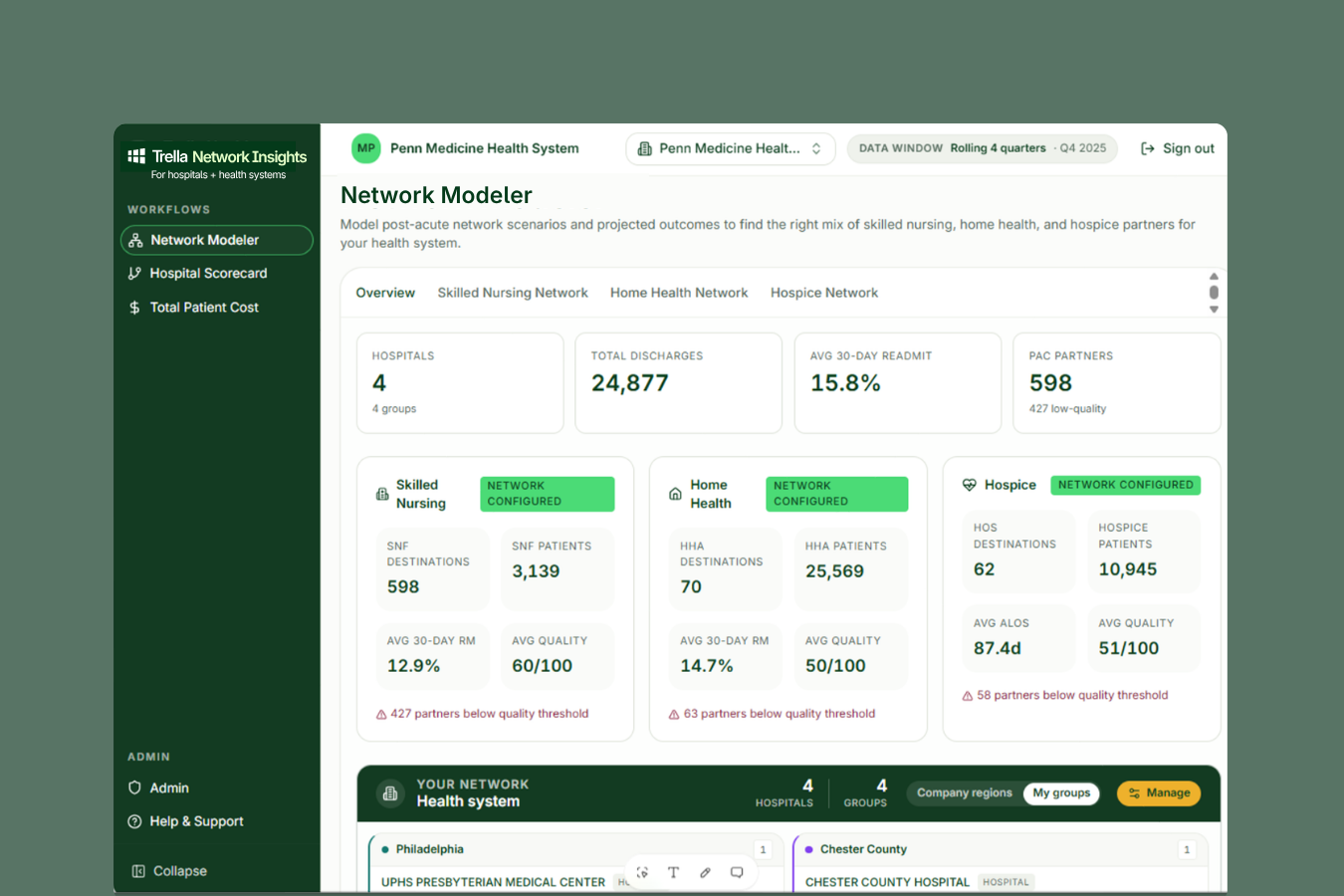
Through its Market Insights platform, Trella enables organizations to:
- Quantify their impact on total Medicare spend
- Benchmark performance against state and national averages
- Identify referral sources driving avoidable utilization
- Visualize patient-level cost and utilization patterns
Instead of saying “we reduce readmissions,” providers can show by how much and for which patient populations. That level of specificity can change conversations with ACO executives.
Why Might Hospice Timing Be a Strategic Lever Under LEAD?
End-of-life care is a significant driver of Medicare spend, and timely hospice enrollment can influence both utilization and cost outcomes. Under LEAD, post-acute providers who can optimize hospice timing may have an opportunity to support ACO performance. Effective follow-up care after a hospital stay — and addressing the root causes of readmissions, including social determinants of health — can help optimize outcomes and ensure patients have the resources they need to manage their health. LEAD is also expected to include Benefit Enhancements and Beneficiary Engagement Incentives that may promote healthy-living activities and support patients after discharge.
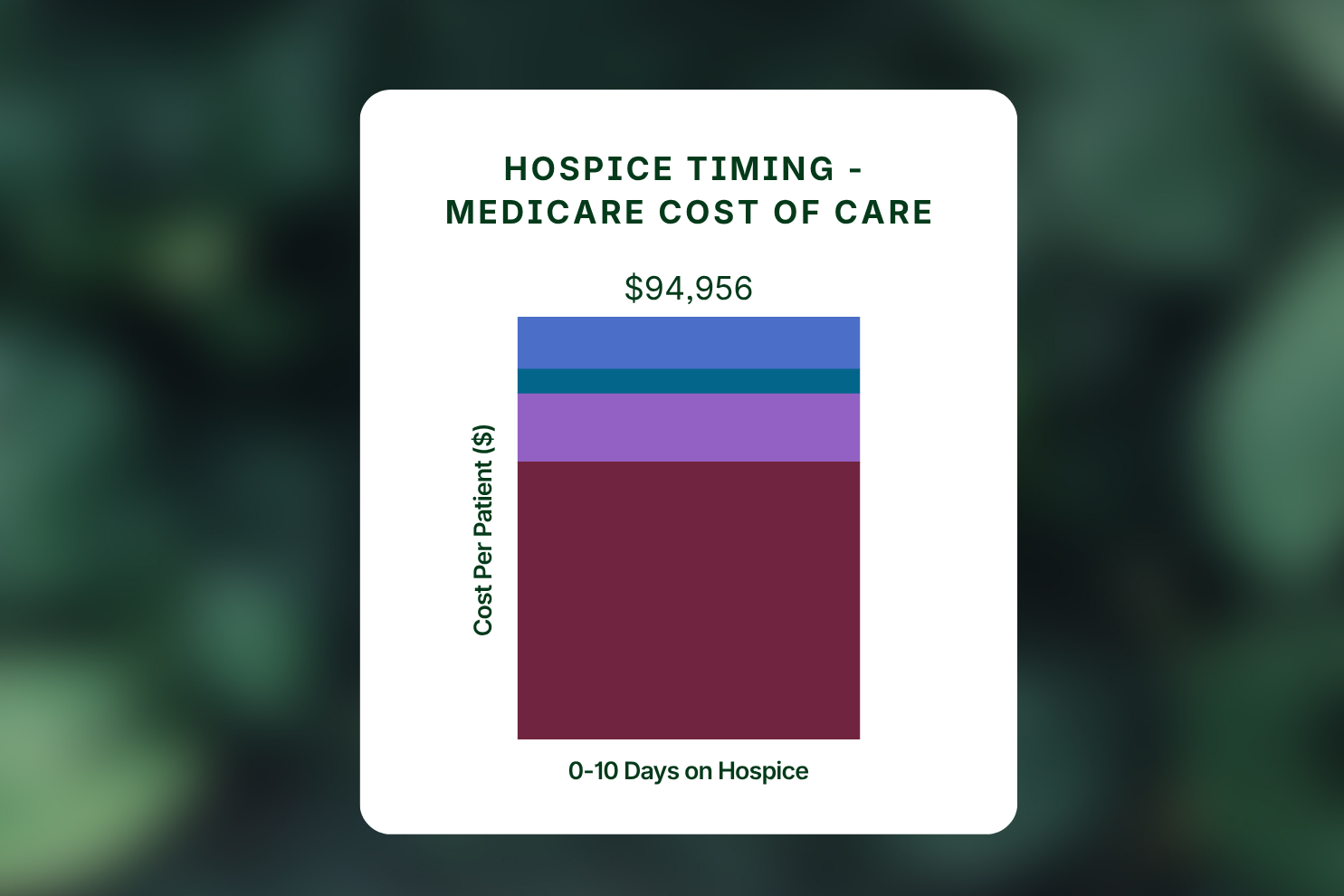
Trella Health’s Hospice Timing Impact metrics, now available in its Marketscape Insights platform, bring greater transparency to how the timing of hospice enrollment relates to Medicare spend and utilization in the final 30–180 days of life.
What Do Hospice Timing Impact Metrics Show?
They provide:
- Claims-backed visualization of spend differences by hospice length of stay
- Hospital and ER utilization patterns tied to referral timing
- Patient-level insights filtered by health condition and time frame, such as 30-day, 90-day, or 180-day periods
- State and national benchmarking
These insights can help hospice providers illustrate how earlier enrollment may be associated with:
- Fewer inpatient days
- Fewer avoidable readmissions
- Lower overall Medicare spend
- Improved patient experience
For ACOs operating under LEAD, this data can serve as both a clinical reference point and a financial planning tool. Trella Health helps providers move from philosophy toward evidence.
Want to learn more about Trella Health’s Hospice Timing Impact metrics? Watch this on-demand webinar for a live demo.
How Does Trella Health Support Preferred Provider Positioning?
Under LEAD, “Preferred Provider” status could become increasingly competitive. ACOs are likely to evaluate partners based on measurable cost containment and quality impact rather than historical relationships alone.
Separately, CMS Administered Risk Arrangements (CARA) could create additional opportunities for preferred providers by enabling episode-based risk arrangements between ACOs and their specialists. CARA is voluntary, however, and is not guaranteed for Preferred Providers — so it is best viewed as a potential pathway rather than a certainty.
Trella Health can help providers:
- Identify high-value hospital and physician partners
- Bring data-backed performance evidence into network discussions
- Highlight areas where competitors drive higher utilization
- Strategically align sales and clinical education efforts
- Support care coordination and, where applicable, the development of episode-based risk arrangements through data sharing and analytics
Rather than waiting to be evaluated, providers can proactively shape the narrative with objective claims data — which may strengthen their negotiating position.
What Makes Trella Health Well Positioned for the LEAD Era?
Trella Health combines three capabilities that may support LEAD readiness:
- Patient-Level Claims Transparency: Granular visibility into Medicare spend, utilization, and referral behavior.
- Market and Competitive Benchmarking: Clear insight into how an organization performs relative to peers.
- Strategic Sales Enablement: Visualizations that translate analytics into value-focused conversations.
LEAD is designed to support provider organizations and primary care providers through payment approaches such as capitated and prospective payments, with the goal of providing greater long-term financial stability, especially for rural or independent practices.
In a risk-bearing environment, insight can become influence. Trella helps bridge the gap between clinical impact and financial accountability.
What Happens to Providers Without This Visibility?
As CMS pushes more risk downstream, providers may find that:
- Referral networks narrow
- Performance scrutiny intensifies
- Contracts increasingly favor measurable cost reducers
Reducing hospital readmissions matters for patient well-being, financial performance, and resource optimization, and readmissions can strain both providers and patients. Providers unable to quantify their impact may find themselves at a disadvantage — not because of poor care, but because their value is harder to see.
Under LEAD, hard-to-measure value can become a real vulnerability.
The Bottom Line: LEAD Points Toward a Data-Driven Era, and Trella Health Can Help
The CMS LEAD Model reinforces a decade-long commitment to value-based accountability. LEAD also aims to support the integration of Medicare and Medicaid services for dually eligible beneficiaries — a component currently focused on two states — creating incentives for providers to coordinate care and improve outcomes for those beneficiaries.
For post-acute providers, the strategic priorities are becoming clearer:
- Demonstrate lower total cost of care
- Quantify Days at Home impact
- Show readmission reduction
- Illustrate measurable hospice timing benefits
Trella Health can help organizations do exactly that. In a market where preferred status may increasingly depend on proof, the differentiator is less likely to be who markets the loudest and more likely to be who can validate their value with data.
Connect with a Trella Health product expert today to learn more.
This level of market and referral visibility can be a real difference-maker.