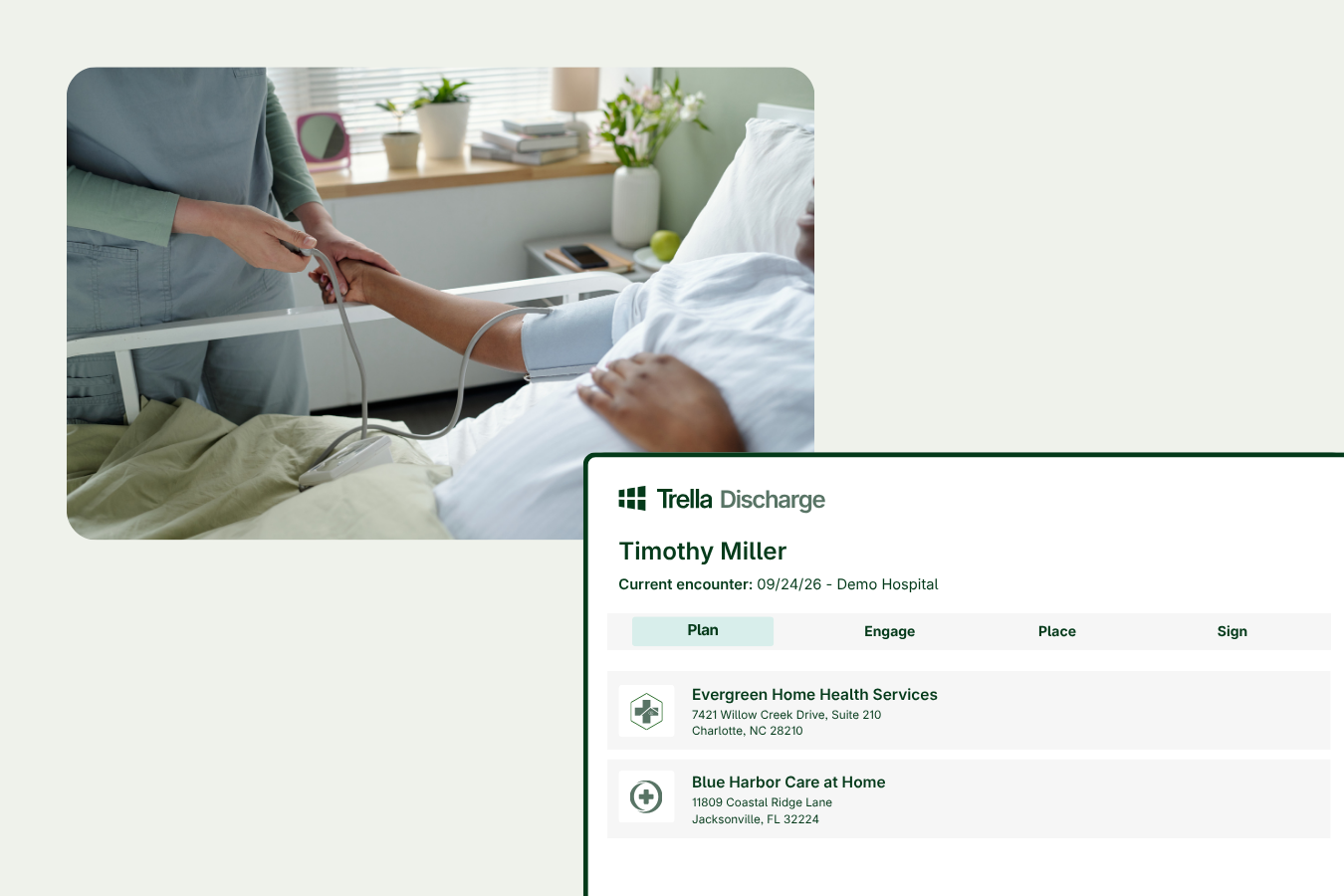
A care manager sends a referral to a skilled nursing facility that looks like a perfect fit. It is in network, it has a bed, and it takes the patient’s Medicare Advantage plan. Except the facility dropped that plan in July, and the bed was filled on Tuesday.
The referral is declined. The next one goes out. The patient spends another day in an inpatient bed.
Most conversations about discharge workflows focus on speed: how fast referrals go out, how many clicks it takes, how quickly providers respond. Speed only helps if the information behind each referral is right. This post looks at the data underneath the workflow, how much of it there is, and why keeping it accurate is the work that decides whether you see results like shorter length of stay.
A single referral depends on a lot of facts
Every post-acute provider in your network has a profile, and that profile holds about 200 fields. Together they answer the question every discharge planner is really asking: can this provider take this patient, with this plan, today?
- The basics: facility name, whether it is still open, who owns it, and the phone and fax numbers where referrals go.
- Payer participation: the largest block, at well over 100 fields. Each provider has its own status for Medicare, Medicaid, commercial plans, and typically 8 to 15 Medicare Advantage plans.
- Clinical capabilities: about 45 per level of care, covering which clinical needs a facility can truly support.
- Quality ratings: Facilities with low-quality ratings may not qualify for special programs like SNF waivers
- Admission criteria and exclusions: who the provider will and will not accept.
- Intake routing and contacts: who is sitting in the intake seat this month and where referrals should go.
- Profile details: amenities and private pay rates.
On top of the profile sits availability, which changes every day. Does this provider have a bed today, and is it the right kind of bed for this patient?
What that adds up to
Take a mid-size health system with 300 post-acute providers in its catchment and about 6,000 post-acute discharges a year. At about 200 fields per provider, that works out to:
- 60,000 live profile fields that all need to stay true.
- 240,000 field checks a year if every profile is verified once a quarter.
- About 1.1 million availability data points a year (10 fields, every day, across 300 providers). That is roughly 109,500 daily requests to send, monitor, and follow up on.
All told, that is around 1.3 million data points managed every year. The numbers scale with your market. At 500 providers, the total passes 2 million.
Why the data does not stay accurate on its own
A provider directory is not something you build once. It starts to decay the day it is finished.
- Payer contracts change. A Medicare Advantage participation list is materially different every 12 months, and mid-year amendments are common.
- Staff turn over. Intake roles at post-acute providers see high turnover, and we plan around roughly 30 percent a year. The person who knew how to update the profile last spring may be gone.
- Facilities close, merge, and change hands. Skilled nursing and home health consolidation is constant. A facility may close or be absorbed into a larger organization, and its name, NPI, and network affiliations get remapped. Phone and fax numbers change along the way, and a referral sent to a number that no longer works goes nowhere.
- Availability expires fast. A bed count is worth very little after 48 hours. Trella Discharge expires availability on purpose, because stale data that still looks current is worse than no data at all.
What it takes to keep it current
Maintaining a network of 300 providers is ongoing operational work with several moving parts:
| Work | What it involves | How often |
| Directory basics | Confirming each facility is still open, its name is current, and its phone and fax numbers work | Ongoing |
| Insurance acceptance | Confirming which insurances (both carrier and plan level) are accepted | Monthly |
| Profile verification | Checking every full provider profile, at about an hour per provider per cycle | Quarterly |
| Availability | Prompting providers, monitoring responses, and chasing the ones who do not answer | Daily |
| Inaccuracy flag triage | Responding when a care manager reports a problem with a profile | 30-minute response target |
| User onboarding and retraining | Training new provider staff as people come and go | As staff change |
| CMS Quality Ratings | Updating CMS STARS ratings including flagging and removing facilities out of compliance | Monthly as CMS updates |
| Ownership monitoring | Tracking mergers, acquisitions, and chain changes, and remapping names, NPIs, and networks | Ongoing |
Most referral portals give providers a place to maintain their own profiles and leave it there. In practice, many providers do not keep them current, so the work lands somewhere else. Someone has to do it. Often that someone is your own care management team, who absorb the gap as extra referrals and rework instead of time with patients.
Where the results come from
The benefit a discharge workflow delivers is the benefit it is capable of multiplied by how accurate the data underneath it is. Strong workflow on weak data produces weak results.
When the data is right, the first referral lands. The facility takes the patient’s plan, has the right bed, supports the clinical needs, and the intake team who receives it knows what to do. Fewer referrals bounce, fewer patients wait for an answer, and fewer end up in a poor-fit placement that sends them back to the hospital. That is where the half-day reduction in length of stay comes from. It is an outcome of accurate data, not a feature you switch on.
When the data is wrong, the workflow looks the same on the screen but behaves differently in practice. Care managers learn not to trust what they see and go back to calling around, and the gains you expected never show up.
What Trella Discharge does behind the scenes
This is the work our team does for you every day. We confirm that facilities are still open and who owns them, and that their phone and fax numbers work. We verify full provider profiles on a quarterly cycle. We prompt providers for availability daily, follow up with non-responders, and see response rates above 80 percent. We triage accuracy flags from your care managers within 30 minutes, retrain provider users as their staff changes, and track mergers and network changes as they happen.
What you see is a provider directory your care managers can trust. What sits behind it is the operation that keeps it that way.
If you would like to see how the data behind your own provider network looks today, or walk through what we maintain behind your discharge workflow, reach out to your Trella Discharge team.